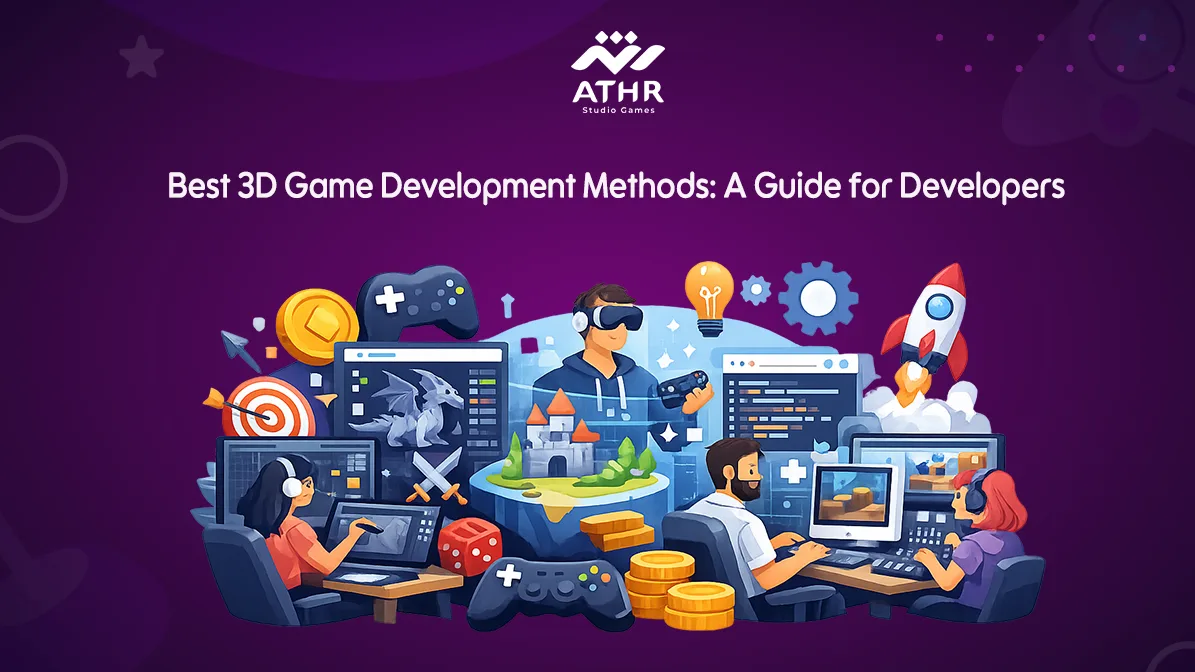
3D Game Dev has become one of the most important fields in digital innovation, thanks to its ability to deliver immersive, realistic, and engaging gaming experiences. Let’s explore the best methods and tools that help developers create professional-quality 3D games with maximum efficiency.
🕹️ Bring your game idea to life with the game development experts at Athr.
What Is 3D Game Development and Why Is It Becoming More Important in the Gaming Industry?
3D game development is the process of creating games that feature three-dimensional environments and characters, providing players with a more realistic and immersive gaming experience. These games are developed using advanced game engines such as Unity and Unreal Engine, which enable developers to build high-quality graphics, smooth animations, visual effects, and interactive gameplay mechanics.
With the growing popularity of open-world games and virtual reality experiences, 3D games have become one of the most widely played and engaging forms of entertainment worldwide.
The Difference Between 2D and 3D Games
Although both types aim to entertain players, there are significant differences between them:
2D Games
- Simpler and faster to develop.
- Ideal for educational games and casual gaming experiences.
- Require fewer system resources and lower performance demands.
3D Games
- Offer realistic environments and highly detailed characters.
- Provide players with greater freedom of movement and exploration.
- Utilize advanced technologies for lighting, physics, and visual effects.
📍 The more realistic and immersive a game becomes, the higher its potential to attract players and improve retention rates. This is why 3D game development has become the preferred choice for startups and professional game studios alike.
Key Benefits of 3D Game Development for Players and Developers
Developing 3D games has become one of the most valuable digital investments due to the significant advantages it offers to both players and developers.
Benefits for Players
- A more realistic and interactive gaming experience.
- High-quality graphics and advanced visual effects.
- The ability to explore expansive and open-world environments.
- Greater interaction with characters and in-game elements.
- Support for Virtual Reality (VR) and Augmented Reality (AR) technologies.
Benefits for Developers
- Greater revenue opportunities through in-app purchases and advertising.
- The ability to create multiplayer 3D games that enhance community engagement.
- Easy scalability with the option to add new updates, features, and levels.
- Cross-platform deployment on mobile devices, PCs, and gaming consoles.
Best Practices Experts Use to Design Professional 3D Games
The success of 3D game development is not solely determined by choosing a powerful game engine. It also depends on delivering an engaging gameplay experience, attractive design, and smooth performance that meets player expectations.
As competition in the gaming industry continues to grow, adopting effective development strategies has become essential to ensuring game quality and long-term success.
The Importance of User Experience in Game Success
User Experience (UX) is one of the most critical factors in successful 3D game development. Even with stunning graphics, a complicated or frustrating gameplay experience can cause players to abandon the game within minutes.
Key Elements of a Successful UX in 3D Games
- A simple and intuitive user interface.
- Smooth controls optimized for different devices.
- Clear in-game instructions and guidance.
- Fast response times for actions and movements.
- A balanced combination of challenge and enjoyment.
At Athr, we conduct user experience testing throughout every stage of game development to ensure a professional gaming experience that increases player engagement and retention rates.
Designing Levels That Drive Engagement and Retention
The more enjoyable and dynamic the game levels are, the more likely players are to continue playing and return regularly. For this reason, developers focus on creating balanced experiences that combine challenge, entertainment, and a constant sense of progress and achievement.
What Makes 3D Game Levels Successful?
Successful levels are built around several key elements that keep players motivated and engaged, including:
- Introducing challenges that gradually increase in difficulty.
- Providing rewards and achievements that encourage continued play.
- Offering diverse missions and objectives to prevent repetition.
- Adding explorable areas and interactive elements within the 3D environment.
- Including surprises and interactive features that enhance gameplay enjoyment.
Strategies for Monetizing Digital Games
Once a game has been launched and begins attracting players, developers can take advantage of several proven monetization models that have demonstrated success across the gaming industry.
Most Popular Game Monetization Models
1. In-App Purchases (IAP)
In-app purchases are among the most common monetization methods. They allow players to buy additional content that enhances their gaming experience, such as new characters, exclusive equipment, cosmetic items, and premium features.
2. In-Game Advertising
Advertising provides a steady revenue stream, especially for free-to-play games. This includes rewarded ads that grant players bonuses for watching them, as well as interstitial ads and short video advertisements.
3. Subscription Models
Some games offer exclusive content, benefits, and premium services through monthly or recurring subscriptions. This model helps generate predictable and recurring revenue while increasing player loyalty.
4. Battle Pass Systems
The Battle Pass model is one of the most successful monetization strategies in modern gaming. It gives players access to exclusive missions, rewards, and progression tiers through seasonal subscriptions, increasing engagement and encouraging long-term participation.
📞 Contact our experts today and receive a customized quote for your game development project.
Steps to Build a Professional 3D Game: From Concept to Launch
The success of 3D game development depends on thorough planning from the very beginning. Early-stage decisions play a significant role in determining the game’s quality, performance, and overall user experience. For this reason, game development is not limited to programming alone—it starts with validating the concept and clearly defining project goals.
The development process includes designing 3D characters and environments, programming gameplay systems and mechanics, conducting extensive testing to ensure optimal performance, and finally launching the game while continuously improving and updating it after release.
Analyzing the Game Concept and Defining the Target Audience
The game concept analysis phase is one of the most important steps in 3D game development because it establishes a clear vision for the project before any design or programming begins.
What Type of Game Do You Want to Develop?
Your game may fall into one of the following categories:
- Action and Adventure Games
- Strategy Games
- Racing Games
- Simulation Games
- Online Multiplayer Games
Each genre requires different design approaches, technologies, and development techniques.
Who Is Your Target Audience?
It is important to identify:
- Age group
- Geographic location
- Preferred gaming devices
- Player interests and preferences
Understanding your audience helps create a more engaging experience and improves player retention rates.
Competitor Analysis
Before developing a professional 3D game, it is essential to analyze competing games to understand:
- Their strengths
- Their weaknesses
- Core gameplay mechanics
- Monetization strategies
Designing 3D Characters and Environments
Once the game concept and mechanics have been finalized, the next step is creating the virtual world in which players will interact. This stage is considered one of the most critical aspects of 3D game development because it directly impacts immersion and player engagement.
Character Design
This process includes:
- Creating concept art
- Building 3D character models
- Applying textures and materials
- Rigging and animation setup
Professional tools commonly used include:
- Blender
- Maya
- 3ds Max
Environment Design
Environment creation may include:
- Cities
- Roads
- Buildings
- Natural landscapes
- Visual effects
The more detailed and polished the environment, the more immersive and realistic the gaming experience becomes.
Testing the Game and Optimizing User Experience Before Release
Testing is one of the most crucial stages of 3D game development because it ensures the game is stable, smooth, and ready for players before launch.
Even visually impressive games can fail if technical issues and gameplay problems are not identified and resolved during testing.
Technical Performance Testing
At this stage, developers evaluate the game’s performance by monitoring frame rates (FPS), memory consumption, server stability, and compatibility across different devices and operating systems.
User Experience (UX) Testing
UX testing focuses on evaluating the player’s overall experience, including character controls, interface clarity, ease of understanding gameplay mechanics, and maintaining the right balance between challenge and enjoyment to maximize engagement.
Optimizing 3D Game Performance
Some of the most effective optimization techniques include:
- Reducing polygon counts
- Compressing textures and assets
- Implementing Level of Detail (LOD) systems
- Optimizing lighting and shadow rendering
- Efficient resource and memory management
These optimizations are especially important for delivering smooth performance on mid-range devices and mobile platforms.
Multiplayer Game Testing
When developing multiplayer 3D games, additional testing is required to ensure stable player connections, accurate synchronization of in-game events, effective anti-cheat systems, and low-latency gameplay. These measures help create a fair, competitive, and reliable multiplayer experience.
🥽 Discover the secrets of professional 3D virtual reality game development in our comprehensive guide.
What Is the Cost of 3D Game Development and What Factors Influence It?
The cost of 3D game development varies depending on the project’s size, graphical complexity, and the features required within the game. The target platform—whether mobile, PC, or console—as well as the number of levels, characters, and gameplay systems also significantly impact the overall budget. For this reason, defining project requirements clearly from the beginning is essential for obtaining an accurate cost estimate and achieving the best possible results.
How Project Scope Impacts the Budget
The size and complexity of a game are among the most important factors affecting the cost of learning, developing, and launching a professional 3D game.
Indie Games
These are relatively simple games with limited levels and core gameplay features.
Key Characteristics:
- Shorter development cycles.
- A limited number of characters.
- Simple 3D environments.
- Lower development costs.
Mid-Sized Games
These games typically include:
- Multiple levels and game stages.
- Progression systems and missions.
- Diverse character sets.
- Advanced user interfaces.
Projects of this scale usually require a team consisting of Unity or Unreal Engine developers, 3D artists, and user experience specialists.
AAA-Style Games
These large-scale projects often feature:
- Open-world environments.
- Advanced artificial intelligence systems.
- Complex gameplay mechanics.
- Online multiplayer functionality.
As project requirements increase, development and testing hours grow significantly, leading to higher overall costs.
💰 Discover the cost of 3D game development and the key factors that influence your project budget.
Publishing, Maintenance, and Future Update Costs
Game development costs do not end once programming is completed and the game is launched. In reality, a new phase begins—one that is just as important as the development process itself.
The long-term success of any game depends heavily on continuous maintenance and regular updates that keep players engaged and extend the game’s lifespan in the market.
- Publishing Costs
Before a game reaches players, it must be prepared for distribution across digital marketplaces. This includes developer account fees for Google Play and the App Store, creating and optimizing the game’s store listing, designing promotional assets, and writing compelling marketing descriptions that help increase downloads.
- Infrastructure Costs for Multiplayer Games
When developing multiplayer 3D games, additional technical requirements arise. These costs may include powerful hosting servers, high-performance databases, security systems to protect player data, and ongoing performance monitoring to ensure a stable gaming experience.
- Ongoing Maintenance and Updates
After launch, the development team must continuously monitor performance and release updates to maintain a high-quality user experience. These updates may include bug fixes, new content and levels, interface improvements, and additional features based on player feedback and market demands.
💬 Contact our experts to learn more about the best game development solutions for your project.
In conclusion, 3D game development is one of the fastest-growing and most innovative fields in the technology industry. It combines creativity, design, and programming to deliver immersive and engaging gaming experiences. By choosing the right tools and following industry best practices, developers can build professional-quality games capable of competing in the global gaming market.
📩 Start your journey with Athr today and launch your professional game to the market.