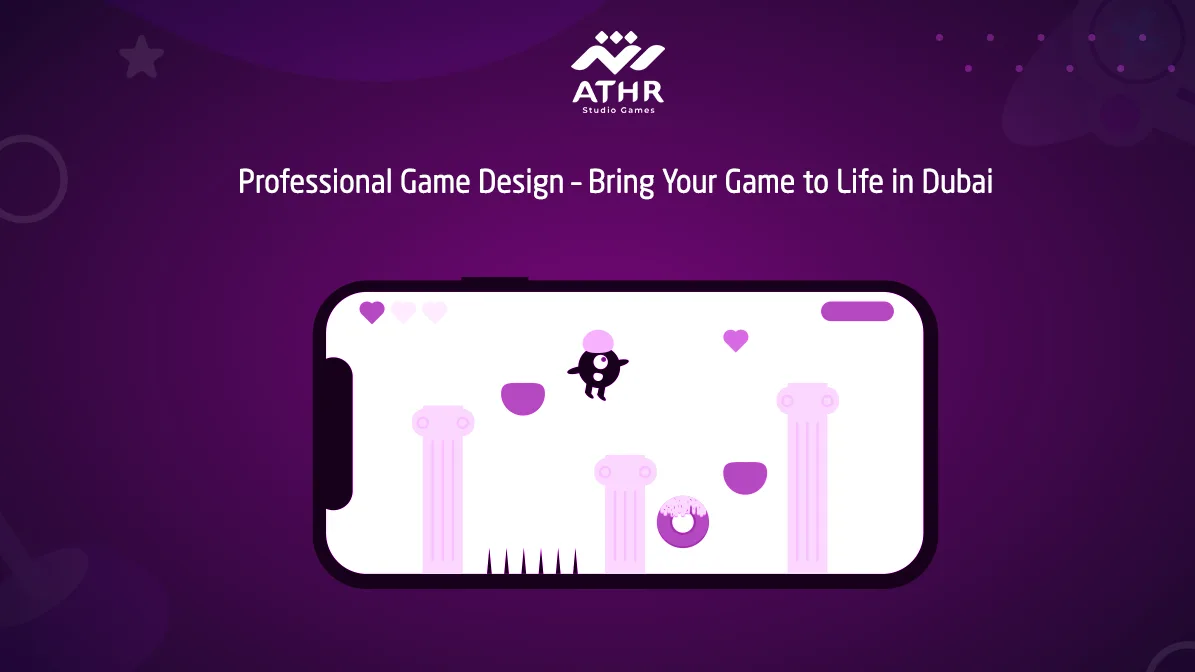
Do you have a game idea and need a team to bring it to life? At Athr, we offer game design services that take your project from concept development through character and level creation, gameplay programming, testing, and launch preparation. We work with you on a clear plan tailored to your audience and project goals in Dubai and the UAE.
Contact us and share your idea to discuss how we can bring it to life.
What Makes Your Game Design Stand Out?
Your project stands out when its concept, gameplay, and player challenges work together. Appealing graphics attract attention, but the way players interact with the experience gives them a reason to keep playing and return.
Before starting game development, establish clear answers to three questions:
- Who is your audience? Children, players looking for competition, or users who prefer short gaming sessions?
- What will the player do? Solve puzzles, race, build a world, or manage resources?
- What is the project’s goal? Generate revenue, deliver educational content, or increase engagement with your brand?
These answers help you evaluate proposals from any game design company and choose which features deserve investment in the first release.
A Clear Concept Gives Your Game a Distinct Identity
A clear concept lets you describe the player experience in a single sentence. For example: “A game where friends compete to deliver orders across a city, choosing different routes and overcoming changing challenges.”
This description defines the core activity and gives the development team a shared starting point. Adding racing, building, trading, and combat from the outset, however, may expand the project’s scope before you have confirmed that its core gameplay is enjoyable.
Choices and Challenges That Make Players Part of the Experience
Players feel involved when they can see the consequences of their decisions. Enjoyable game design therefore relies on clear choices that influence progression, such as selecting a route, deciding when to use an ability, or allocating resources.
In a store management game, for example, players might choose between expanding the display area and increasing stock. Each decision has a benefit and a cost, giving them room to plan and try different approaches.
Balancing an Easy Start with Gradually Increasing Difficulty
An accessible beginning gives players a chance to understand the rules and feel that they are making progress. Gradually increasing challenges then maintain their interest by building on the skills they have learned and introducing new elements at the right time.
For example, a racing game might begin by teaching steering, then introduce turns, followed by obstacles and opponents. This allows players to learn through gameplay instead of facing every rule on a lengthy instruction screen.
How Do You Test Difficulty Progression?
Start by testing the opening levels and observe:
- Does the player understand the next step without help?
- Where do they retry, and what causes them to struggle?
- Does the game provide feedback that helps them improve?
- Do they feel that success depends on their skills and decisions?
- Are they eager to continue to the next level?
Your idea deserves attention to detail. Explore Athr’s game development services in Dubai.
Custom Game Design Gives Your Project a Unique Identity
Custom game design allows you to build an experience around your idea, from characters and environments to gameplay rules and progression systems. Every element has a clear role in creating a cohesive experience that serves players and reflects your project’s identity.
To achieve this, agree on three foundations with your development team before production begins:
- Game identity: The concept, emotions, and overall tone you want to convey.
- Audience needs: Players’ ages, languages, interests, and device usage habits.
- Project goal: Entertainment, education, or increased engagement with your brand.
These foundations help any game design company propose a suitable development scope and clarify what the first release needs and what can be added later.
Creating a Story and Visual World That Reflect Your Idea
The story gives players a reason to take part, while the visual world helps them understand and engage with the experience. The story does not need to be long; a clear objective, such as restoring a city or discovering new places, may be enough to connect the levels.
For example, you could build an adventure game around a character searching for missing pieces in a fictional city inspired by the Gulf region. Buildings, clothing, colours, and sound effects would then work together to create a world with its own distinct character.
Tailoring Progression and Reward Systems to Your Players
Games become more enjoyable when players can see the results of their efforts. With every completed mission, they develop their skills, unlock a new level, or earn a tool that helps them tackle upcoming challenges. In professional game design, we make progression clear and deliver rewards at the right time.
We also choose rewards that suit the game and its audience, whether they are additional abilities or character customisation items, keeping the experience enjoyable and giving players something to look forward to.
Adapting Content for Arab and Gulf Audiences
A game feels more relevant to players when its language is natural, its dialogue is clear, and its characters and details suit their culture. Adapting content for Arab and Gulf audiences therefore extends to menus, instructions, and visual elements, making the experience accessible and familiar.
When choosing a game development company in Dubai, make sure it considers Arabic support from the beginning. This includes letter rendering, text direction, and number formatting, alongside interface testing to ensure clarity and ease of use in both Arabic and English.
Details That Make the Experience More Relevant to Your Audience
- Clear language: Short instructions suited to the player’s age.
- Appropriate references: Names, environments, and details that fit the game world and its audience.
- Suitable audio: Voice acting and pronunciation that reflect the characters.
- Flexible interfaces: Enough room for Arabic text, with testing of element direction and layout.
- Real user testing: Testing the content with people from the target audience.
For example, you could offer a business management game with a clear Arabic interface and a commercial setting inspired by Gulf markets, alongside an English version for the UAE’s wider audience. These requirements should be defined early because they affect production scope, testing, and game development costs.
How Does Our Experience in Dubai Shape Your Game?
Our experience in Dubai helps us understand your audience and choose what suits them, from dialogue and character design to challenges and rewards. We turn that understanding into details that help players grasp the game easily and enjoy progressing through it.
At Athr, we start by discussing your idea and goals, then create a game design plan that fits your budget. We review the experience with you throughout development to ensure that its details work together and bring your vision to life.
Designing Content for the UAE Market and Arab Audiences
We begin by understanding your game’s target audience so we can choose suitable language, graphics, and ways to present instructions. A children’s game needs simple explanations and clear elements, while games for young adults may benefit from more complex dialogue and challenges.
We also make sure the experience feels natural to Arab audiences, from dialogue writing to character choices and cultural details. Clear menus and correctly displayed Arabic text help players understand and interact with the game easily.
Turning Project Requirements into Practical Design Decisions
We turn your project requirements into specific details the team can implement. If you want to add player competition, for example, we define how players participate, the winning conditions, and how results are calculated and displayed.
In custom game design, we prioritise these details and explain the time and cost each requires, allowing you to choose what suits your project before development begins.
Steps to Turn Your Idea into a Clear Scope of Work
- Define your game’s goal: Entertainment, education, or increased audience engagement with your brand.
- Clarify the gameplay: What does the player do? How do they win or lose? How do they control the game?
- Choose the platform and graphics style: Identify the target devices and whether the graphics will be 2D or 3D.
- Prioritise development: Define the features required for launch and those that can be added later.
- Test a prototype: Try the core gameplay and refine the parts that need improvement.
- Agree on delivery criteria: Document the required functionality and how it will be verified before project handover.
With these steps, you begin development knowing what will be delivered and how to review each stage through to handover.
Explore ideas that have grown from initial plans into playable experiences.
Measuring Your Game’s Success After Launch
A game’s success is measured through indicators that reflect its goals and the experience it offers, such as level completion, player retention, and stable performance. Download numbers alone do not show whether users enjoy the experience and continue playing.
Make measurement part of your game development plan from the outset. Define the events you need to track, such as starting a level, completing it, and retrying, so you can interpret the results after launch.
Tracking Level Completion and Player Retention
Tracking level progress reveals how well players understand challenges and move through them. Player retention shows whether the experience gives them a reason to open the game again after their first session.
Start with a focused set of metrics and assess them together instead of relying on a single number:
- Tutorial completion: Are players learning the basic rules?
- Completion of each level: Where do players progress, and where do they stop?
- Number of attempts: Does the challenge require a reasonable amount of practice, or does it repeatedly leave players stuck?
- Player retention: How many players return in the days following their first experience?
- Session length: Does it suit the game type and the length of its tasks?
How Do You Calculate the Level Completion Rate?
Divide the number of players who completed the level by the number who started it, then multiply the result by 100. Count each player only once during the measurement period.
If 200 players start a level and 120 complete it, the completion rate is 60%. To understand this figure, review the level’s difficulty, the clarity of its instructions, and the game’s performance during play.
In mobile game design, comparing completion rates across devices and game versions helps identify whether a lower rate is linked to challenge difficulty or a performance issue.
Identifying Drop-Off Points and Improving Difficult Sections
A drop-off point is where a player stops progressing through the experience. This may happen during registration, content loading, instructions, or a challenge they do not understand how to overcome.
To identify the cause, connect engagement data with player feedback and crash reports. A user leaving after repeated losses is different from one leaving because the game freezes or responds slowly.
Practical Steps for Analysing Player Drop-Off
- Identify where the drop occurs: Use Google Analytics for Firebase to compare how players move between screens and levels.
- Review what happens beforehand: Are there new instructions, a difficulty increase, or a loading screen?
- Segment the results: By device, language, and game version.
- Test a specific hypothesis: Such as an unclear objective or difficult controls.
- Make a measurable change: Then compare the results using a suitable sample and measurement period.
If you notice players leaving when a new tool is introduced, you may need a short demonstration showing how to use it during gameplay. Test this explanation before changing the overall difficulty.
Prioritising Updates Based on Data and Player Feedback
Prioritise updates that address the problems with the greatest impact on players. If the game crashes when a level opens, fixing that issue comes before adding characters or new items.
As you continue game development, review usage data alongside audience feedback. The data may reveal that players leave a particular level, while their comments explain that the instructions are unclear or the controls are difficult to use.
How Do You Decide What to Implement First?
Before approving an update, ask:
- Number of affected players: How many players encounter the issue?
- Impact: Does it prevent gameplay or affect a small part of the experience?
- Available evidence: Is it supported by usage data or repeated reports?
- Implementation requirements: How much time and money will it take to address the issue and test the solution?
You can then prioritise bug fixes, improvements to onboarding and controls, level adjustments, and new content. The order will vary according to your game’s condition and actual results.
Your idea deserves a team that understands it and cares about everything that makes it enjoyable for players.
At Athr, we bring our experience in Dubai to game design that combines your vision with quality execution.